


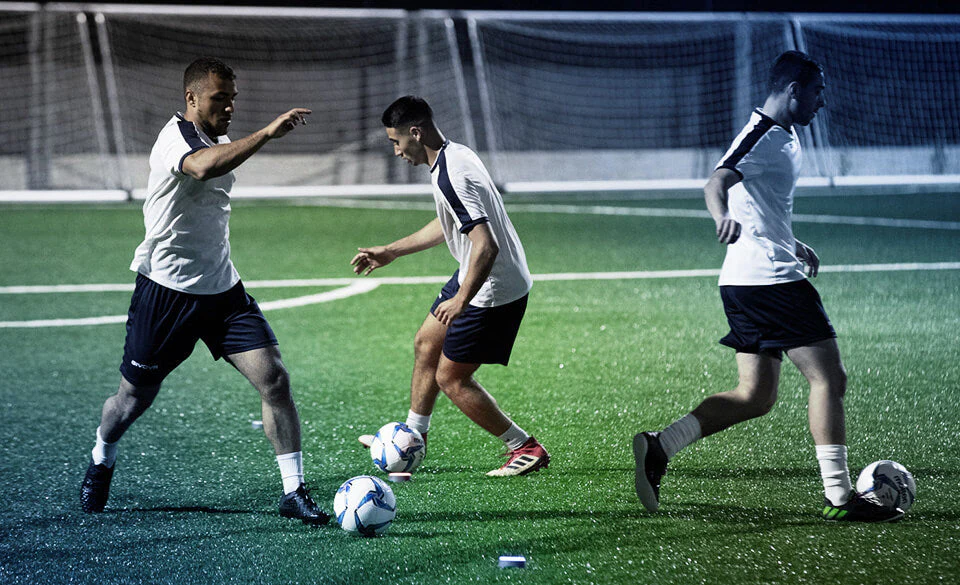
Soccer isn’t just about natural ability anymore. At the elite level—and even at the youth and amateur levels—the difference between players often comes down to training. Talent might open the door, but training keeps you in the game and gives you the edge. Today’s game demands a blend of speed, strength, and technical skill. If you want to rise above the competition, your training approach needs to be smarter, sharper, and more complete than ever.
Building Real Speed, Not Just Running Fast
Speed in soccer isn’t just straight-line sprinting. It’s about explosiveness, acceleration, and being able to repeat bursts throughout a 90-minute match. Most players think running more will make them faster. It won’t. Real speed comes from training your neuromuscular system to fire more efficiently and your body to move with purpose.
Sprint training is only one part of the picture. Short bursts—like 10 to 20 meters—mimic game scenarios better than long-distance sprints. Starting from a static position, pivoting and then accelerating, is closer to how players actually move on the pitch. Plyometric exercises like bounding, lateral hops, and depth jumps help train your body to generate force quickly. This is how you improve your first step, not by jogging or running laps.
Acceleration and deceleration mechanics matter too. Soccer players rarely get a full sprint in. Most of their movement is made up of micro-accelerations and sudden stops, followed by changes in direction. Drills that teach your body how to control momentum—planting with stability, pushing off explosively—build the kind of usable speed that translates into match performance.
And then there’s frequency. You can’t just work on speed once a week and expect it to stick. Speed needs to be trained consistently and in fresh conditions. Doing sprint work when your legs are already dead won’t develop explosiveness—it’ll just reinforce poor mechanics. Prioritize it early in your session when your nervous system is fresh, and don’t overdo the volume.
Strength Training That Actually Works for Soccer
Too many soccer players are still afraid of lifting weights, worried that they’ll bulk up and lose agility. That mindset is outdated. Done right, strength training makes you faster, more durable, and more efficient. It’s not about becoming a bodybuilder. It’s about becoming a better athlete.
The right kind of strength training is built around compound movements—squats, deadlifts, lunges, presses, and pulls. These moves target multiple muscle groups, replicate sport-specific movements, and improve coordination between joints. They also make your body more resilient. If you’re dealing with injuries or want a personalized program, a sports medicine specialist in Medford can help optimize your training and recovery. You can’t expect to survive a season full of tackles, awkward landings, and constant collisions without a strong frame.
But strength isn’t just about the weight room. Bodyweight control and core engagement matter just as much. A player who can control their body in mid-air or hold position under contact without fouling has a huge advantage. That comes from functional strength—training muscles to work together rather than in isolation.
There’s also a timing factor. In-season training should look different from off-season training. During the off-season, you can load heavier, push volume, and focus on building strength and power. In-season, the focus shifts to maintaining that strength and avoiding fatigue. Smart periodization means you never have to choose between performance and recovery—you balance both. Global hospitality consultants can provide valuable insights into how this balance can be applied in various industries.
Skill Is Still King
All the physical tools in the world won’t help you if your touch is off, your passing is sloppy, or your decision-making lags. Skill remains the most important piece of the soccer puzzle. Even something as simple as practicing footwork with summer slides can sharpen your control and balance. The best training programs don’t separate physical and technical work—they fuse them. Every drill should include a ball when possible, and every rep should have intention behind it.
Skill training doesn’t mean just juggling or hitting free kicks. It’s about working on the things you actually do in matches—first touch under pressure, dribbling at speed, receiving with the back foot, scanning before a pass. These aren’t flashy; they’re fundamental. And they’re what elite players master.

One of the most effective ways to sharpen skill is through small-sided games. Tight spaces force quicker decisions, more touches, and better communication. They replicate the pressure of real match play, but in a controlled environment. Unlike static drills, these games build not just technique but game intelligence. It’s also important to ensure that your assets, such as equipment, are properly covered, just like how renters’ insurance in GA can offer peace of mind for those in the area.
Repetition matters, but not mindless repetition. Skill training should include variation—different angles, different surfaces, and changing pace. The goal is adaptability. Soccer is chaotic, and the best players are the ones who can adjust on the fly without losing control.
Conditioning That Prepares You for the Chaos
Running for the sake of running doesn’t prepare you for a soccer match. The game is a series of sprints, jogs, walks, and all-out efforts with minimal rest. Conditioning for soccer needs to reflect this chaotic pattern. That means high-intensity interval training with soccer-specific movement patterns.
Think repeated sprint efforts with short recovery. Think direction changes, defensive tracking, and movement with the ball. The goal is to build an engine that doesn’t quit, not just lungs that can handle a jog. You want to be the player who’s still making runs in the 85th minute when everyone else is gassed. Just like creating an impactful commercial wall mural, it’s all about endurance, vision, and delivering something that lasts long after the initial effort.
It’s also important to train both anaerobic and aerobic systems. Your anaerobic system fuels those explosive sprints and challenges. Your aerobic base helps you recover between them. One without the other leaves you vulnerable—either you burn out quickly or can’t go hard when it counts.
And recovery is part of conditioning. If your body can’t bounce back from hard efforts, you’ll never be consistent. This is where sleep, nutrition, and mobility work become non-negotiables. Training is only half the equation; recovery is the other half. Neglect it, and you won’t see results.
Mental Training and Game IQ
The best players don’t just react—they anticipate. They read the game, make decisions quicker, and see options others miss. This comes from experience, but also from intentional mental training. Watching film, studying positioning, and reflecting on decisions all help develop soccer IQ. In the same way, applying focused services like vacation rental cleaning services can help ensure every aspect of preparation is covered, enhancing the experience.
Visualization is another underrated tool. Rehearsing game scenarios in your head, seeing yourself make the right play, can reinforce neural pathways just like physical reps. Mental reps help build confidence, reduce hesitation, and create a deeper understanding of how you play and how you can improve.
Pressure training also builds mental toughness. Putting yourself in uncomfortable situations—like practicing penalties after a hard session or scrimmaging when you’re tired—forces you to focus under stress. That mental edge is often the difference between players who show up when it counts and those who disappear.
Putting It All Together
No single method wins on its own. Speed, strength, and skill have to be trained together, not in isolation. The best soccer players train like complete athletes. They sprint with power, they move with control, and they play with intelligence. Their training is intentional, their recovery is deliberate, and their mindset is focused. If you are looking for a holistic approach to fitness, consider integrating medical weight loss services in Wisconsin to support your goals.
Success in soccer doesn’t come from grinding blindly. It comes from training with purpose, being honest about your weaknesses, and doing the work that others avoid. The best training methods don’t just make you better in the gym or faster in drills—they make you more effective where it counts: on the pitch.
When you train to build speed, strength, and skill in a balanced, smart, and relentless way, you set yourself apart. And in a game where the margins are razor-thin, that edge can be everything.