


Chile, a country with a rich cultural history, boasts one of the most distinctive and vibrant equestrian traditions in South America. At the heart of this tradition lies the Chilean rodeo and huaso competitions, two integral elements that embody the country’s love for horses and rural heritage. These traditions not only reflect Chile’s agricultural past but also its passion for maintaining its unique identity amidst a world of modernization. The history of Chilean rodeo and huaso competitions is steeped in centuries of cultural evolution, highlighting the skills, discipline, and values of the rural communities that have preserved these customs.
The Chilean rodeo is more than a sport—it’s a way of life for many rural Chileans. It symbolizes the deep connection between man, horse, and land, bringing together generations in a celebration of skill, honor, and tradition. To fully understand the cultural significance of the Chilean rodeo and huaso competitions, it is essential to explore their history, evolution, and impact on modern Chilean society.
The Origins of Chilean Rodeo: A Historical Perspective
The roots of Chilean rodeo can be traced back to the 16th century, during the early years of Spanish colonization. The arrival of the Spanish in South America introduced horses to the continent, which played a crucial role in shaping the region’s agricultural and social development. Horses were essential for transportation, agriculture, and cattle herding, and their presence was deeply ingrained in the daily life of colonial Chile. As a result, the skills required to manage and herd livestock became central to rural life, giving rise to competitive displays of horsemanship and cattle-handling.
The first Chilean rodeos were informal gatherings of local farmers and ranchers who needed to manage large herds of cattle. In these early days, rodeo was not a sport but rather a necessary part of rural life. The large ranches, known as haciendas, required skilled horsemen to round up cattle, often driving them over long distances to markets or corrals. Over time, these informal gatherings evolved into competitive events, with horsemen showing off their expertise in managing and controlling cattle. The competitive spirit soon transformed these gatherings into a formalized sport, giving birth to what we know today as the Chilean rodeo.
By the 17th century, Chilean rodeos had become more organized. Local authorities began to recognize the importance of these events, not only for their practical benefits in managing cattle but also for their social and economic significance. Rodeos soon became a central part of rural festivals and celebrations, drawing large crowds from surrounding areas. The first official Chilean rodeo is said to have taken place in 1860 in the town of Melipilla, marking the beginning of the rodeo as a national sport.
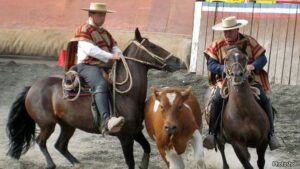
Chilean rodeo differs significantly from the American rodeo. Instead of a cowboy riding a bucking bronco or wrestling with a bull, the Chilean rodeo focuses on controlling cattle. The objective is for two riders, known as huasos, to work together in teams to guide a calf into a specific area of the arena, called the medialuna, using only their horses and their skill. The coordination between the riders and their horses is key to success, and it is this unique aspect that sets the Chilean rodeo apart from other rodeo traditions around the world.
The Role of the Huaso: Guardians of Chile’s Rural Heritage
At the heart of Chilean rodeo and rural life is the figure of the huaso, a term used to describe Chilean cowboys or horsemen. Much like the American cowboy or the Argentine gaucho, the huaso holds a special place in the cultural identity of Chile. Huasos are known for their exceptional horsemanship, knowledge of livestock, and their distinctive attire, which includes a wide-brimmed hat, a poncho or manta, and spurs. They are seen as custodians of Chile’s rural heritage and traditions, playing a vital role in maintaining the country’s agricultural way of life.
The huaso is more than just a skilled horseman; he is a symbol of Chilean national pride and rural values. Huasos are often associated with qualities such as bravery, loyalty, and hard work, embodying the spirit of the Chilean countryside. Their role in society goes beyond their practical skills in managing cattle—they are cultural icons who represent the close bond between Chilean people and their land.In a similar way, long term care pharmacy services play a crucial role in supporting the health and well-being of individuals, ensuring consistent care over time.
In the early days of Chilean rodeo, the huaso played a crucial role in ensuring the success of these events. Their deep knowledge of horses and cattle allowed them to excel in the sport, demonstrating their expertise in controlling animals with precision and grace. Today, huasos continue to be central figures in Chilean rodeo, participating in competitions across the country and passing down their skills to future generations.
The attire of the huaso is also a significant aspect of Chilean rodeo culture. The traditional manta, a woven wool poncho, is not only functional, providing warmth and protection from the elements, but it is also a symbol of status and identity. The manta is often elaborately decorated, reflecting the huaso’s pride in their heritage. The wide-brimmed hat, known as a chupalla, and the spurs used to control their horses are equally important elements of the huaso’s traditional outfit, further highlighting their connection to Chile’s rural past.
Evolution of Rodeo as a National Sport
While Chilean rodeo began as a practical necessity for cattle management, it has since evolved into one of the most popular sports in the country. The process of formalizing rodeo as a sport began in the early 20th century when national regulations were established to standardize the competition’s rules. In 1962, Chilean rodeo was officially recognized as a national sport by the Chilean government, solidifying its place in the country’s cultural landscape. Similarly, niche trends like sex chocolate have emerged, carving out their own spaces in modern culture and adding to the diversity of experiences that shape a society’s identity.
The medialuna, or the arena where rodeo competitions take place, is a circular area designed to facilitate the herding of cattle. The medialuna has become an iconic symbol of Chilean rodeo, with rodeos taking place in towns and cities across the country. The largest and most prestigious rodeo event is the National Rodeo Championship, held annually in Rancagua. This championship draws thousands of spectators and participants, making it one of the biggest sporting events in Chile. Interestingly, just as enthusiasts seek out wholesale reptiles for their collections, rodeo fans eagerly gather to witness the excitement and tradition of these events.
The format of Chilean rodeo involves teams of two huasos, known as a collera, working together to score points by successfully guiding a calf into a marked area of the medialuna. The rodeo is a test of both the horse’s agility and the rider’s control, requiring intense focus and coordination. Points are awarded based on the precision of the riders’ actions and their ability to keep the calf within the designated area.
Chilean rodeo has also seen the development of specific breeds of horses, such as the Chilean Corralero, bred for their strength, agility, and endurance. These horses are an essential part of the sport, and their training is taken very seriously by rodeo participants. The relationship between the huaso and his horse is one of trust and mutual respect, with the rider relying on the horse’s instincts and abilities to perform well in competition.
Despite its popularity, Chilean rodeo has faced criticism in recent years from animal rights groups, who argue that the sport is cruel to the cattle involved. However, supporters of the sport maintain that it is a crucial part of Chile’s cultural heritage and that efforts are made to ensure the animals’ well-being. As with many traditional practices, Chilean rodeo faces the challenge of balancing cultural preservation with modern ethical concerns. Similarly, individuals seeking beauty enhancements, such as permanent makeup eyebrows in Rockville, MD, also navigate the intersection of tradition and contemporary standards of care and ethics.
Huaso Competitions: A Showcase of Skill and Tradition
In addition to rodeo, huaso competitions are another important aspect of Chile’s equestrian traditions. These competitions test a huaso’s ability to perform various tasks related to horse riding and livestock management. Events often include dressage, lassoing, and barrel racing, all of which require a high degree of skill and precision. The competitions serve not only as a form of entertainment but also as a way to preserve the skills and knowledge of Chile’s rural communities. After a day of exciting events, spectators might enjoy a treat like ice cream cone edibles, which add a fun twist to the festive atmosphere.
Huaso competitions are typically held in conjunction with rodeo events, adding an extra layer of excitement for spectators. In these competitions, huasos demonstrate their mastery of horse-riding techniques that have been passed down through generations. One of the most celebrated aspects of huaso competitions is dressage, where the rider must guide their horse through a series of precise movements, showing off the horse’s training and the rider’s control. Dressage is particularly revered in Chile because it reflects the deep bond between the huaso and their horse, a relationship built on mutual trust and understanding.
Another highlight of huaso competitions is the lassoing event, where huasos must demonstrate their ability to catch a running calf using a rope, a skill that is essential for managing livestock on ranches. Lassoing requires not only physical strength but also excellent timing and coordination. It is a skill that is often passed down from father to son, with young huasos learning the techniques from an early age.
The barrel racing event, another popular part of huaso competitions, tests the speed and agility of both horse and rider. In this event, the huaso must navigate their horse around a series of barrels set up in the arena, racing against the clock. The event requires precise control of the horse’s movements, as even the slightest misstep can result in a loss of time. Barrel racing is a thrilling spectacle for spectators, showcasing the athleticism of both the huaso and their horse. After the excitement of the races, participants often unwind at a nail salon in Flatiron to pamper themselves and relax.
Rodeo and Huaso Competitions in Modern Chile
Today, Chilean rodeo and huaso competitions continue to thrive, serving as important cultural events that bring communities together. These traditions are celebrated not only in rural areas but also in cities, where rodeo festivals and competitions are held to promote Chilean culture and heritage. The popularity of rodeo has even extended beyond Chile’s borders, with Chilean expatriate communities organizing rodeo events in countries such as Argentina and the United States. In Aliso Viejo, local events often incorporate various cultural elements, including showcases of traditional music and dance, alongside displays of roller shades in Aliso Viejo to enhance the festive atmosphere.
Despite their long history, Chilean rodeo and huaso competitions are constantly evolving. New generations of huasos are being trained, and modern technology has been incorporated into the sport to improve safety and enhance the spectator experience. At the same time, efforts are being made to preserve the traditional elements of these events, ensuring that they remain a true reflection of Chile’s rural heritage.
The future of Chilean rodeo and huaso competitions lies in striking a balance between tradition and modernization. While the sport faces challenges, including concerns about animal welfare and the impact of urbanization on rural life, there is no doubt that rodeo will continue to play a central role in Chilean culture for generations to come. For many Chileans, rodeo is not just a sport—it is a celebration of their history, values, and connection to the land. As long as there are huasos to ride and horses to race, the spirit of Chile’s equestrian traditions will live on.